
Sources for Torrance Previous Residents
The strongest previous residents trail combines a property source with an occupant source. The deed chain carries ownership and legal description. The Torrance and South Bay directory run carries listed people and addresses. The Herald and Press add moves, deaths, and public events. Census images add household relationships. Permits explain physical change. Probate can connect a deceased owner to representatives or heirs. Each source covers a different time and role.
| Source | Years it covers | Where held | What it shows |
|---|---|---|---|
| Recorded instruments | 1850-present | LA County RR/CC | Grantors, grantees, legal descriptions, liens, dates |
| Torrance and South Bay directories | 1922-1975 | Torrance Library digital collection | Listed occupants, spouses, addresses, street sequence |
| Torrance Herald | 1914-1969 | Torrance Public Library | Obituaries, moves, notices, civic and family clues |
| Federal population census | Through 1950 public | NARA and partner databases | Household members, relationships, age, address where recorded |
| Torrance permits | Archived and recent divisions | City portals or responsible county department | Work chronology and project participants |
| Sanborn fire maps | Verify item years | Library of Congress and repositories | Building footprint, use, materials, additions |
The Los Angeles County Registrar-Recorder/County Clerk is the property-record custodian. Its office route is more important than the presence of a modern web page because the public Internet does not expose an unrestricted remote grantor-grantee name index.
The county office image marks the starting custodian for a Torrance previous residents chain, while the later evidence comes from different shelves.
Start With Torrance AIN and Legal Key
Open the LA County Assessor Portal by address, accept the suggested result, and capture the AIN, situs, municipality or unincorporated indicator, legal lot or block clues, and map link. The modern street address is a useful search handle. The legal description is the more durable bridge when an older deed omits the current situs label. Compare the parcel with Torrance GIS when a postal Torrance address may fall outside city government.
Save the current acquisition deed if available, then keep the AIN and legal description beside the grantor, grantee, recording date, and instrument number. A tax-mail destination may differ from the situs and may belong to a trust, business, or service address. Do not use it as proof that an owner lived at the parcel. These distinctions keep previous residents separate from prior title holders.
The modern address and parcel procedure is detailed in the Torrance streets workflow; the backward trail begins after its AIN step.
Walk the Seller to an Earlier Grantee
To trace past owners, read the current deed from today’s grantee back to the seller. The seller’s earlier acquisition becomes the next search target. Search the prior grantee as a grantee, bracket the date, and follow the legal description. Repeat until the chain reaches the period that matters. The recorder index is organized around grantor and grantee names, document type, recording date, instrument number, and older book and page references. It is not a simple street-address history.
- Confirm the target parcel and current AIN in the Assessor Portal.
- Obtain the current acquisition instrument or identify its document number, book and page, or copy route.
- Write down the grantee, grantor, recording date, legal description, and any APN or instrument identifier.
- Search the prior owner backward as grantee, then repeat with the earlier seller and the same legal land description.
- Pair each ownership interval with directories, newspapers, permits, probate, or census evidence before calling someone a past resident.
- Grantor
- The party transferring an interest in a recorded instrument.
- Grantee
- The party receiving an interest in that instrument.
- Chain of title
- The connected sequence of recorded interests for the same land.
- Legal description
- The deed’s land identifier, such as a lot, block, tract, or other recorded description.
A deed strongly shows an interest in property. It does not show that the grantee moved in, stayed through the full interval, or represented every person in the home.
Where Torrance Recorder Books Begin in 1850
Los Angeles County reports recorded property documents from 1850 forward. That early date reaches beyond Torrance’s 1921 incorporation and can preserve the county land trail before the city series begins. The public access lesson is just as important as the date: digitization does not mean an open remote name index. If an address search fails, use the known party, legal description, document number, or book and page, then move to Norwalk viewing, the office index, or a copy request.
The county’s real-estate page provides viewing and ordering routes. The California Public Records Act is not a substitute for a recorder-specific service when the record is already held under a deed index and copy procedure. Ask for an identifiable existing instrument. Older books may be handwritten or organized by references that do not look like a modern address.
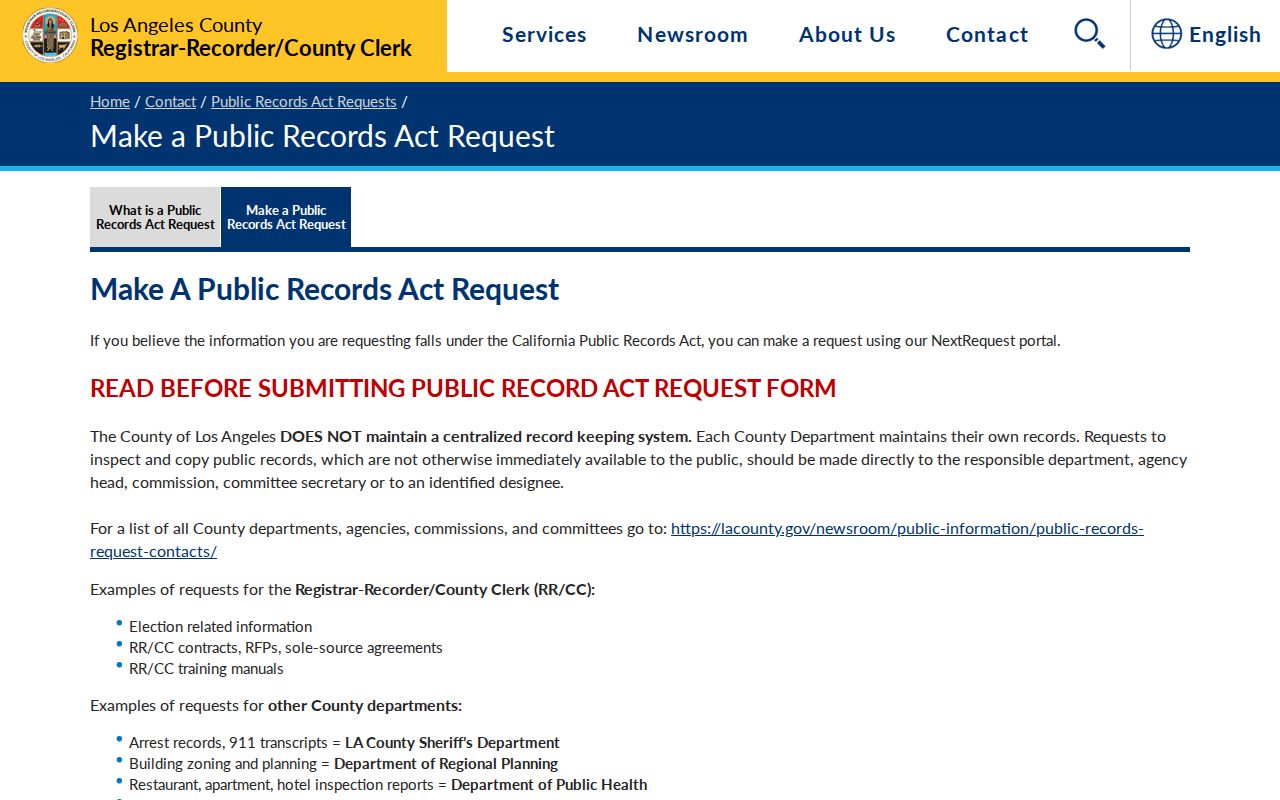
The county request-routing page helps separate recorder questions from court, tax, planning, and Sheriff records.
Note: “Records maintained from 1850” identifies the county series, not a claim that every page from that year is online or immediately available.
Add Torrance’s 1922-1975 Occupant Layer
The local directory run starts soon after incorporation and gives the property chain a human layer. Search the alphabetical section for a known name, then use the criss-cross section to read a street and house number. Capture the exact volume title, publisher, year, page, spouse notation, address, telephone, and marks such as h, r, wid, or ret. A directory listing reflects a canvass and can lag the date printed on its cover.
The Torrance Herald from 1914 through 1969 and the Peninsula or Torrance Press from 1949 through the 1964 merger can explain a move, death, sale, club tie, or family change. Search the newspaper alongside the directory rather than using it as a substitute for a certificate. The Historical Society supplied the directory material, and library reference staff can help with a missing volume or hard scan.
The complete historical collection method sits in the Torrance city directory archive, where the directory shelf can be read without confusing it with the current deed chain.
Pair Torrance Directory With the 1950 Census
A census and a directory overlap without answering the same question. The public 1950 census can show names, relationship to head, age, birthplace, marital status, and work-related fields, with street or house number where recorded. A directory may show a listed address, spouse, telephone, and short household marks. Pair the closest directory year with the closest census and compare the image, not only a transcription.
Use this flow: directory name or address -> census household -> next directory year -> Herald or Press clue -> deed, probate, or vital confirmation for the specific fact. If a household vanishes, search under a spouse, surname variant, business name, and old address. A new occupant does not reveal where the earlier person went. The 72-year rule leaves much of the later gap to directories, newspapers, permits, and family-held material.
Enumeration can place multiple units under one number, and publication can lag the canvass. Keep the source date and role in the log rather than writing a continuous-residence claim from two matching addresses.
Use Torrance Permits to Date Physical Change
Permit records can explain a new addition, demolition, subdivision, or address gap. Torrance’s archived Document Portal takes Street Number and Street Name. The more recent Citizen Access system can search Record Number, Address, or Parcel and requires an account or login for permit searching. Search both divisions when a historic address is quiet in the directory or when a building form changes.
A permit identifies work and a project participant. It does not prove the applicant owned the parcel or lived there. Building plans are inspected at the One-Stop Permit Center, and county building or planning staff may hold a record when the parcel is outside Torrance limits. Use the permit date to bracket a physical change, then use the directory and newspaper to ask who was listed before and after it.
The Torrance Citizen Access portal is the current city permit route.
Close a Trail With Probate and Obituary
Probate and obituary research can close a previous residents trail when a household member died or an estate changed hands. Search the LA Superior Court probate class by decedent, capture the case number, and inspect public petitions, notices, representatives, and orders. The Herald can supply an obituary date, spouse, relatives, service note, or address clue. Then order an informational death copy when eligible and use the deed or probate instrument for the property event. That combination often gives previous residents a dated endpoint.
Keep the roles apart. An obituary may name family members but omit an address. A probate petition may list an heir or representative but not prove that person lived at the house. A deed may move title without showing occupancy. The prior-residents trail is strongest when at least one property source and one occupant or family source agree on a date.
Survive Address Changes With Lot and Block
Street names, numbers, and postal forms can change, while lot, block, tract, AIN, and legal description persist. When a directory entry does not match the modern address, retain its printed form and compare cross streets, maps, subdivision language, permits, and the deed legal description. A modern ZIP should not be retrofitted to a pre-1963 directory listing, and a postal Torrance label should not be used as proof of city jurisdiction.
Sanborn fire-insurance maps can show footprint, use, material, and additions when an item exists for the relevant place and year. They are building evidence, not a list of previous residents. The Library of Congress Sanborn collection is a catalog and access lead; verify the actual Torrance item before relying on it. The official California statutes portal supplies the legal text when an address rule or access citation needs checking.
The official statute reference image belongs with address-history cautions because legal access rules and historical keys both outlast a simple street label.
Ask Torrance Library and Historical Society
No formal Torrance house-history guide was located in the research. The documented fallback is practical: ask Torrance Public Library reference staff about the directory and newspaper collection, then ask Torrance Historical Society about photographs, maps, ephemera, and local context. The museum is in the 1936 former main library at 1345 Post Avenue. Library staff can identify a shelf or database, but they do not disclose patron activity or certify a person’s identity.
Use the California State Archives, NARA, the Library of Congress, and a FamilySearch catalog for broader series. Record a clear gap when a volume, map, or deed image cannot be located. An offline or restricted source is not evidence that the person never lived at the address. A documented gap is a valid house-history result.
Always state whether a fact came from a deed, a directory, a newspaper, a census, a permit, or a family-history lead. That small label prevents previous residents from being confused with prior owners.